
You know when you break a small part of a household appliance and struggle to find an exact replacement? Or when you come up with a brilliant idea for a personalized gadget but have no clue how to get it made? Chances are, 3D printing and injection molding are the manufacturing heroes lurking behind these scenarios. The choice between these two methods can make a huge difference. This guide is here to help you sort it all out. We’ll dig deep into what 3D printing and injection molding are all about, compare them side by side in every aspect, from how they work and what they cost, to their environmental impacts and future trends. Whether you’re just dipping your toes into the manufacturing pool or you’ve been swimming in it for years, you’ll find the insights you need to make smart decisions and get the best results for your projects.
Principles of 3D Printing and Injection Molding
3D Printing
Layer-by-Layer Construction
3D printing, also known as additive manufacturing, builds objects by adding material layer upon layer. The process begins with a digital 3D model, which is sliced into thin cross-sections. A 3D printer then deposits material, such as plastic filament (in Fused Deposition Modeling – FDM), liquid resin (in Stereolithography – SLA), or powder (in Selective Laser Sintering – SLS), following the pattern of each slice until the complete object is formed.
Varieties of Technologies
- FDM: Widely used due to its affordability and ease of use. It extrudes heated plastic filament, suitable for prototyping and hobbyist projects.
- SLA: Utilizes ultraviolet light to cure liquid resin, offering high precision and smooth surface finish, making it ideal for detailed models and dental applications.
- SLS: Sinteres powder materials using a high-power laser, enabling the production of complex geometries and functional parts with a wide range of materials, including metals.
Injection Molding
Mold-Based Production
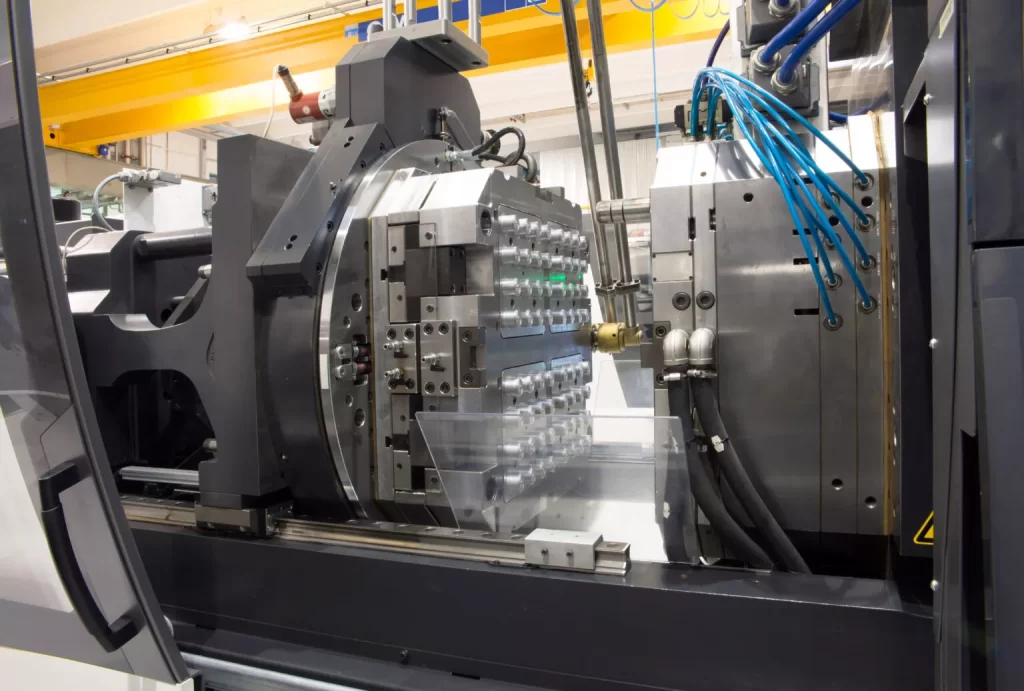
Injection molding involves melting thermoplastic or thermosetting materials and injecting the molten material under high pressure into a custom-designed mold cavity. The mold, typically made of metal, is precision-engineered to define the shape of the final product. After the material cools and solidifies inside the mold, the part is ejected, ready for further processing or use.
Key Components and Process Flow
- Injection Machine: Comprises an injection unit (for heating and injecting the material), a clamping unit (to hold the mold closed during injection), and a control system (to manage temperature, pressure, and timing parameters).
- Mold: Made up of a movable half and a fixed half, with channels (runners) to guide the molten material and a cooling system to accelerate solidification. The design and quality of the mold are crucial for product quality and production efficiency.
What’s the difference between 3D Printing and Injection Molding?
1. Design Flexibility
- 3D Printing
- Complex Geometries: Can effortlessly create intricate shapes like lattice structures, internal cavities, and topological optimization designs that are challenging or impossible to achieve with traditional manufacturing. For instance, in aerospace, 3D printing is used to produce lightweight engine components with complex internal cooling channels.
- Customization: Easily accommodates individual design requirements, allowing for personalized products. In the medical field, custom prosthetics and dental implants can be printed based on patient-specific data.
- Rapid Iteration: Design changes can be implemented quickly by simply modifying the digital model and reprinting, shortening the product development cycle.
- Injection Molding
- Mold Constraints: Limited by the need for mold release, designs must incorporate draft angles, uniform wall thicknesses, and avoid undercuts. Otherwise, parts may not eject properly or could damage the mold. For example, plastic housings for electronics require careful design considerations to ensure smooth production.
- Design Stability: Once the mold is fabricated, design changes are costly and time-consuming, as a new mold must be produced. This makes it essential to finalize the design before mass production.
2. Material Selection
- 3D Printing
- Diverse Materials: Supports a wide array of materials, including plastics (PLA, ABS, nylon, etc.), metals (stainless steel, titanium, aluminum powders), ceramics, and composites. Each material offers unique mechanical, thermal, and chemical properties, catering to various application needs. For example, nylon is favored for its strength and flexibility in functional parts, while ceramic materials are used for high-temperature and wear-resistant applications.
- Material Compatibility: Different 3D printing technologies work best with specific materials. For instance, FDM is commonly paired with thermoplastic filaments, while SLA requires liquid resins. Some advanced printers allow for mixing materials to achieve enhanced properties.
- Injection Molding
- Thermoplastic Dominance: Primarily uses thermoplastic materials like polyethylene (PE), polypropylene (PP), and polycarbonate (PC) due to their recyclability and excellent molding characteristics. These materials offer a balance of cost, strength, and processing ease, suitable for mass-produced consumer goods.
- Thermosetting Applications: Although less common, thermosetting plastics like phenolic resins and epoxies find use in applications demanding high dimensional stability, heat resistance, and chemical resistance, such as in electrical insulation components.
3. Dimensional Accuracy and Tolerance Control
- 3D Printing
- Technology-Dependent Accuracy: Varies significantly depending on the printing technology. FDM generally has lower accuracy, with layer thickness and material shrinkage affecting the final dimensions. In contrast, SLA and SLS can achieve higher precision, with SLA offering micron-level accuracy in some cases. However, post-processing steps like curing and polishing may also introduce dimensional changes.
- Tolerance Management: Meeting tight tolerances can be challenging, especially for large or complex parts. But continuous advancements in printer calibration and software control are improving accuracy. For example, in the production of small mechanical parts, careful calibration and optimization of print parameters can help achieve acceptable tolerances.
- Injection Molding
- Mold-Driven Precision: The precision of injection molding is largely dictated by the quality of the mold. High-precision machining techniques and strict quality control during mold fabrication ensure micron-level accuracy of the mold cavity. This, combined with precise control of injection parameters (temperature, pressure, speed), enables consistent production of parts with tight tolerances. For instance, in the optical industry, injection molding is used to produce lenses with extremely precise dimensions.
4. Production Speed and Efficiency
- 3D Printing
- Print Speed Variation: Different 3D printers operate at different speeds. Consumer-grade FDM printers are relatively slow, often taking hours to complete a moderately sized object. Industrial SLA and SLS printers are faster but still slower than injection molding when it comes to mass production. However, for small batches or urgent prototypes, the lack of mold-making time can be an advantage.
- Batch Production Consideration: As the number of parts increases, the time required for 3D printing grows proportionally due to its layer-by-layer nature. Additionally, post-processing, such as removing support structures and surface finishing, adds to the overall production time. For example, printing a batch of 100 small figurines with FDM would take considerably longer than producing the same quantity using injection molding.
- Injection Molding
- High-Speed Reproduction: Once the mold is set up and optimized, injection molding can produce parts at a rapid pace. The injection cycle, including injection, packing, cooling, and ejection, can be as short as a few seconds per part, enabling high-volume production. For example, in the toy industry, thousands of plastic toys can be produced in a short time frame using injection molding.
- Multi-Cavity Molds: To further boost production efficiency, molds can be designed with multiple cavities, allowing for the simultaneous production of several parts in one injection cycle. This significantly reduces the per-unit production time and cost.
5. Surface Quality
- 3D Printing
- Layered Surface Appearance: Due to the layer-by-layer construction, 3D printed parts typically exhibit visible layer lines, resulting in a rougher surface finish compared to injection molding. Even with fine print settings, achieving a mirror-like surface is difficult. For example, in consumer products like phone cases printed with FDM, the layer lines may be noticeable and require post-processing to improve aesthetics.
- Post-Processing Needs: Common post-processing methods include sanding, polishing, painting, and electroplating to enhance surface smoothness, color, and gloss. However, these processes add time, cost, and may introduce additional dimensional changes if not carefully controlled.
- Injection Molding
- Mold-Determined Quality: The surface quality of injection molded parts is mainly determined by the finish of the mold cavity. By using precision machining and surface treatments like polishing, chrome plating, or texturing on the mold, extremely smooth and visually appealing surfaces can be achieved. For example, in the automotive industry, injection molded interior panels have a high-gloss finish that meets strict aesthetic requirements.
- Process Parameter Influence: Injection parameters also play a role in surface quality. Incorrect settings can lead to surface defects such as flow marks, sink marks, and weld lines. By carefully adjusting these parameters, manufacturers can minimize such defects and ensure consistent high-quality surfaces.
Cost Analysis of 3D Printing and Injection Molding
Equipment and Infrastructure Investment
- 3D Printing
- Printer Cost Range: Consumer-grade 3D printers can be purchased for a few hundred to a few thousand dollars, making them accessible for hobbyists and small businesses. Industrial-grade printers, especially those capable of advanced materials and high precision, can cost tens of thousands or more.
- Operating Expenses: Include consumables like filaments or resins, energy consumption, and routine maintenance. Filament costs vary depending on the material and quality, and energy consumption is relatively modest for most printers. Maintenance involves tasks such as nozzle cleaning, calibration, and replacement of worn parts.
- Injection Molding
- Injection Machine Cost: High-quality injection machines start at tens of thousands of dollars and can escalate significantly depending on the size, complexity, and capabilities. Larger machines with more advanced features are required for mass production of large parts.
- Mold Cost: This is often the most significant expense in injection molding. Custom molds can range from a few thousand to hundreds of thousands of dollars, depending on factors such as size, complexity, material, and precision requirements. Mold design, fabrication, and testing are time-consuming and labor-intensive processes.
Material Cost
- 3D Printing
- Material Price Variation: Different 3D printing materials have different price points. Common filaments like PLA are relatively inexpensive, while specialty materials like metal powders or high-performance resins can be costly. The amount of material used depends on the part’s volume and design, with complex geometries sometimes requiring more material due to support structures.
- Material Recovery: Some 3D printing processes allow for partial material recovery. For example, unused powder in SLS can be recycled, although there may be limitations on the number of times it can be reused.
- Injection Molding
- Material Cost Calculation: Based on the volume of the part, density of the material, and unit price, the material cost is relatively straightforward to calculate. Bulk purchasing of thermoplastic materials can often reduce the per-unit cost. However, waste material from runners and gates must also be accounted for, although this can usually be recycled.
Labor Cost and Skill Requirements
- 3D Printing
- Operational Labor: Operating a 3D printer is generally straightforward, requiring minimal training for basic use. However, more advanced applications, such as optimizing print parameters for high-quality results or designing complex models, may demand specialized knowledge. Post-processing tasks like sanding and painting also require manual labor and some level of skill.
- Design and Engineering Skills: Creating or modifying 3D models demands proficiency in computer-aided design (CAD) software. Additionally, understanding material properties and printability is crucial for successful 3D printing projects.
- Injection Molding
- Mold Design and Fabrication: Skilled engineers and technicians are needed to design and fabricate molds. This involves knowledge of mechanical design, material science, and precision machining. Mold design errors can lead to costly production issues, so experienced personnel are essential.
- Production Operation: During production, operators must monitor and control injection parameters, ensure proper mold clamping, and handle any potential issues. Training in injection molding processes and safety is required to maintain efficient and safe operations.
Production Scale and Cost-Effectiveness
- 3D Printing
- Cost Curve for Small Batches: For small production runs (typically less than 100 units), 3D printing can be cost-effective as it eliminates the need for expensive mold-making. The cost per unit remains relatively stable as the number of parts decreases, making it suitable for prototyping, custom parts, and niche markets.
- High-Cost Barrier for Large Batches: As the production volume increases, the time-consuming nature of 3D printing and the relatively high cost of materials compared to injection molding make it increasingly expensive. For example, producing 1000 identical parts with 3D printing would likely cost much more than using injection molding.
- Injection Molding
- Scale Economy Advantage: Injection molding exhibits significant economies of scale. As the number of parts produced increases, the fixed cost of the mold is spread over more units, leading to a dramatic decrease in the per-unit cost. For large-volume production (more than 1000 units), it becomes the more economical choice, providing consistent quality and low cost.
- Break-Even Analysis: Determining the break-even point between 3D printing and injection molding is crucial for making cost-effective decisions. Factors such as the cost of the mold, production volume, material cost, and labor cost must be carefully considered.
Environmental Impact Assessment
Energy Consumption
- 3D Printing
- Print Process Energy Use: Different 3D printing technologies consume varying amounts of energy. FDM printers generally have lower energy consumption, mainly during the heating of the extruder and the movement of the print bed. SLA and SLS printers, which use lasers or UV lamps, consume more energy, especially during long print runs. However, overall energy consumption is relatively small compared to large-scale manufacturing processes.
- Post-Processing Energy Demand: Post-processing steps like curing (in SLA) or sintering (in SLS) additional energy. For example, in SLA, the post-curing process requires UV light exposure for a certain period, increasing the total energy footprint.
- Injection Molding
- Injection Machine Energy Consumption: Injection machines consume significant energy, mainly for heating the barrel to melt the material and maintaining the mold temperature. The energy consumption varies depending on the size of the machine, the material being processed, and the production cycle time. Larger machines and longer production runs result in higher energy use.
- Cooling System Energy Requirement: The cooling system, which is essential for solidifying the injected material, also consumes energy. Efficient cooling systems are designed to minimize energy waste while ensuring rapid cooling.
Material Sustainability
- 3D Printing
- Environmental Impact of Materials: The environmental footprint of 3D printing materials varies. Some plastics, like PLA, are biodegradable, reducing long-term waste concerns. However, metal powders and certain resins may have more complex environmental impacts, including extraction and processing requirements.
- Material Recycling and Reuse: As mentioned, some 3D printing materials can be recycled, but the efficiency and feasibility of recycling depend on the technology and material. For example, in FDM, recycled filaments may have reduced mechanical properties, limiting their reuse.
- Injection Molding
- Material Recycling Practices: Injection molding commonly uses thermoplastic materials, which are highly recyclable. Scrap material from runners, gates, and defective parts can be reground and reused in subsequent production runs. However, the quality of the recycled material may need to be monitored to ensure product performance.
- Sustainable Material Options: Manufacturers are increasingly exploring sustainable thermoplastic alternatives, such as bio-based plastics, to reduce the environmental impact of injection molding.
Waste Generation and Treatment
- 3D Printing
- Support Structure Waste: In many 3D printing processes, support structures are necessary to build overhanging or complex parts. These support structures are often discarded after printing, generating waste. Although some printers can minimize support structure use, it remains a challenge in terms of waste reduction.
- Unused Material and Failed Prints: Unused material left in the printer and failed prints also contribute to waste. However, with proper management and recycling, some of this waste can be mitigated.
- Injection Molding
- Runner and Gate Waste: The runners and gates, which direct the molten material into the mold cavity, are cut off after injection and become waste. While they can be recycled, the process of separating and reprocessing them requires additional resources.
- Defective Parts: Defective injection molded parts must be disposed of or recycled, depending on the nature of the defect. Quality control measures are implemented to minimize the number of defective parts produced.
Application Case Studies
3D Printing Case Studies
- Aerospace Component Production
In the aerospace industry, 3D printing has enabled the production of complex engine parts with intricate internal cooling channels. By using SLS technology, companies can reduce weight, improve fuel efficiency, and shorten development cycles. For example, a leading aerospace firm was able to produce a critical engine component in weeks instead of months, thanks to 3D printing. - Medical Prosthetics Customization
In the medical field, 3D printing is revolutionizing the way prosthetics are made. By scanning a patient’s residual limb, a custom prosthetic can be designed and printed, ensuring a perfect fit and improved mobility. A patient with a below-the-knee amputation received a 3D printed prosthetic that was lighter, more comfortable, and tailored to his specific needs.
Injection Molding Case Studies
- Automotive Interior Mass Production
Automotive manufacturers rely heavily on injection molding for interior components. For example, the dashboard of a modern car is typically produced using injection molding. The process allows for high-quality, consistent production of complex shapes, with a variety of textures and colors. A major car company produces thousands of dashboards per day, meeting the demands of mass production. - Consumer Electronics Enclosure Manufacturing
In the consumer electronics industry, injection molding is used to produce the enclosures of devices like smartphones, tablets, and laptops. The precision and surface quality achieved through injection molding ensure that the products look sleek and professional. A well-known electronics brand uses injection molding to produce millions of phone cases per year, with strict quality control to maintain a high-gloss finish.
Future Trends Outlook
Technological Breakthroughs
- 3D Printing
- New Material Developments: Researchers are constantly exploring new materials for 3D printing, such as high-strength composites, biodegradable polymers, and conductive materials. These new materials will expand the application range of 3D printing, enabling the production of more functional and sustainable products.
- Printing Speed Enhancement: Efforts are underway to increase the speed of 3D printing without sacrificing quality. Technologies like high-speed extrusion in FDM and parallel processing in SLA are being developed to reduce print times and make 3D printing more competitive in mass production scenarios.
- Hybrid and Multi-Material Printing: The ability to print with multiple materials simultaneously or in a hybrid manner is advancing. This will allow for the creation of parts with complex material gradients and enhanced functionality, such as sensors embedded within a structural component.
- Injection Molding
- Intelligent Injection Systems: The development of intelligent injection molding systems that incorporate machine learning and real-time monitoring is on the rise. These systems can optimize injection parameters based on sensor feedback, reducing defects and improving productivity. For example, by continuously analyzing the temperature and pressure inside the mold, the system can automatically adjust the injection speed to ensure uniform filling.
- Micro-Injection Molding Advancements: As the demand for smaller and more precise components grows, micro-injection molding techniques are evolving. This includes the development of specialized molds and injection equipment capable of handling micron-sized parts, opening up new applications in fields like microelectronics and medical devices.
Market Demand Changes
- 3D Printing
- Growing Demand for Personalized Products: Consumers are increasingly seeking personalized products, and 3D printing is well-positioned to meet this demand. From custom jewelry to personalized home decor, 3D printing allows for one-of-a-kind creations. This trend is driving innovation in the design and marketing of 3D printed products.
- Sustainability-Driven Applications: With environmental concerns mounting, 3D printing’s potential to use recycled materials and reduce waste is attracting attention. Companies are exploring ways to incorporate recycled plastics and biodegradable materials into 3D printing processes, aligning with sustainable development goals.
- Injection Molding
- Mass Customization Requirements: While injection molding is traditionally associated with mass production, there is a growing need for mass customization. Manufacturers are looking for ways to combine the efficiency of injection molding with the flexibility of customization. This could involve using modular molds or advanced manufacturing techniques to produce variants of a basic product design.
- High-Quality and Functional Requirements: In industries such as automotive and electronics, consumers expect not only aesthetically pleasing products but also those with high functionality and durability. Injection molding will continue to evolve to meet these demands, with improvements in material selection and processing techniques.
Industry Fusion and Emerging Applications
- 3D Printing
- Cross-Industry Collaborations: 3D printing is facilitating cross-industry collaborations. For example, in the medical and fashion industries, 3D printed wearable medical devices are being developed. These devices can monitor vital signs while also serving as a fashion accessory, combining the functionality of healthcare with the aesthetics of fashion.
- New Application Frontiers: In fields like food printing and construction, 3D printing is making inroads. Scientists are experimenting with printing edible structures and even building small structures using large-scale 3D printers, opening up entirely new possibilities for these industries.
- Injection Molding
- Integration with Other Technologies: Injection molding is increasingly being integrated with other technologies, such as 3D printing for mold fabrication. By using 3D printing to create molds, manufacturers can reduce the lead time and cost of mold production, especially for complex or low-volume molds.
- Emerging Market Opportunities: As new industries emerge, injection molding will find applications. For example, in the renewable energy sector, injection molding could be used to produce components for solar panels or wind turbines, taking advantage of its ability to produce large quantities of high-quality parts.
Decision-Making Guide
Product Characteristics Analysis
- Geometric Shape and Complexity
- If the product has a highly complex geometric shape, with features like internal cavities, lattice structures, or undercuts that are difficult to machine, 3D printing may be the preferred choice. For example, a custom-designed implant with a porous structure for better tissue integration would be best produced using 3D printing.
- Conversely, if the shape is relatively simple and can be easily molded, injection molding may offer a more efficient and cost-effective solution. A standard plastic bottle, for example, is well-suited for injection molding.
- Size Requirements
- For very small or micro-sized parts, micro-injection molding or specialized 3D printing techniques may be required. The choice will depend on the precision and quantity needed. For example, in the production of microelectronics components, micro-injection molding might be favored for its ability to produce high-precision parts in large quantities.
- For large parts, injection molding can handle them if the production volume justifies the investment in a large mold. However, some large-scale 3D printers are also emerging, and they could be considered depending on the complexity and customization requirements of the part.
- Functional Properties
- If the product requires specific material properties, such as high strength, heat resistance, or conductivity, the choice of material and manufacturing process must be carefully considered. 3D printing offers a wide range of materials, but injection molding may have an advantage in terms of material consistency and cost for some applications. For example, a heat-resistant component for an industrial oven would likely be produced using injection molding with a suitable thermoplastic material.
Production Needs Assessment
- Production Quantity Prediction
- For small production runs (less than 100 units), 3D printing is often more cost-effective as it avoids the high cost of mold-making. It also allows for quick design changes and customization. For example, a startup producing custom-designed phone cases for a niche market would benefit from 3D printing.
- For large production volumes (more than 1000 units), injection molding offers significant economies of scale. The fixed cost of the mold is spread over many units, resulting in a lower per-unit cost. A toy manufacturer producing thousands of a popular toy would rely on injection molding.
- Delivery Time Requirements
- If a quick turnaround is needed, 3D printing can be advantageous as it can start production immediately without the need for mold fabrication. For urgent prototypes or small orders, 3D printing can deliver parts in a matter of hours or days.
- Injection molding, once the mold is ready, can produce parts at a rapid rate. But the lead time for mold making can be several weeks or months, depending on the complexity of the mold. So, for long-term, high-volume production with a more flexible delivery schedule, injection molding is a better option.
Cost Budget Consideration
- Short-Term and Long-Term Cost Analysis
- In the short term, 3D printing may have a lower upfront cost as it requires only a printer and materials. However, for large production volumes, the cumulative cost of materials and time can be high. Injection molding has a high initial investment in the mold, but the per-unit cost decreases as production volume increases.
- Long-term cost considerations also include maintenance and upgrades for both the 3D printer and injection molding equipment. For example, a 3D printer may need frequent nozzle replacements and calibration, while an injection molding machine may require periodic mold refurbishment.
- Cost-Effectiveness Balance Point
- Determining the break-even point between 3D printing and injection molding is crucial. This involves analyzing factors such as the cost of the mold, production volume, material cost, and labor cost. By plotting cost curves for both processes, manufacturers can identify the production quantity at which one process becomes more cost-effective than the other.
Quality Standard and Surface Requirements
- Precision and Tolerance Standards
- If the product requires extremely tight tolerances, injection molding, with its high-precision mold and controlled injection process, is usually the better option. For example, in the production of optical lenses or precision mechanical parts, injection molding can meet the stringent tolerance requirements.
- 3D printing can achieve acceptable tolerances in some cases, especially with advanced techniques and careful calibration. But for applications where precision is critical, injection molding should be considered.
- Surface Gloss and Smoothness Expectations
- If a high-gloss or extremely smooth surface is desired, injection molding, with its ability to produce parts with mirror-like finishes, is the way to go. For example, in the production of consumer electronics enclosures or automotive interior trim, injection molding can meet the aesthetic requirements.
- 3D printed parts typically have a rougher surface due to the layer-by-layer construction. While post-processing can improve the surface quality, it adds time and cost. So, depending on the surface expectations, the choice between the two processes should be made.
Conclusion
3D printing and injection molding each hold their own unique positions in the vast landscape of modern manufacturing. 3D printing has shattered traditional design constraints, offering unparalleled freedom to bring the most intricate and personalized concepts to life, especially in small-batch and bespoke production arenas. It empowers innovators, hobbyists, and niche businesses to quickly iterate and materialize their visions.
On the other hand, injection molding stands as a stalwart of mass production, consistently churning out high-quality, precision parts with remarkable efficiency and cost-effectiveness when volumes soar. It has been and will continue to be the backbone of industries reliant on standardized, large-quantity output.
Remember, the key to harnessing the full potential of these technologies lies in a thorough understanding of your project’s specific demands. Consider the product’s geometry, the required production scale, your budgetary limitations, and the desired quality benchmarks. Armed with the insights gleaned from this guide, you are now well-equipped to make that pivotal choice between 3D printing and injection molding.