
When people first encounter copper, brass, and bronze, it’s easy to get confused. All three share a similar warm, reddish-gold tone and are often used in overlapping applications. Yet, despite their visual similarities, they are not the same material. They differ in chemical composition, mechanical properties, processing methods, and even historical significance. Understanding these differences is crucial for engineers, designers, and even hobbyists, because choosing the right alloy can directly impact cost, performance, and durability.
This article will take you step by step through the key distinctions between copper, brass, and bronze—from their elemental makeup to real-world applications. By the end, you’ll not only be able to tell them apart but also know when to choose each material for a specific project.
Why Are Copper, Brass, and Bronze Often Confused?
At first glance, they look similar. A shiny brass fitting and a polished bronze statue might both appear golden-brown, while pure copper sheets glow with a reddish tone. For someone outside the manufacturing world, the nuances are subtle. The confusion is also reinforced by language: in some cultures or markets, all three may be loosely referred to as “copper” products. This is because copper is the parent element that forms the basis of brass and bronze.
But just like how steel and cast iron are both based on iron yet behave differently, copper alloys also show distinct personalities depending on what elements are mixed in.
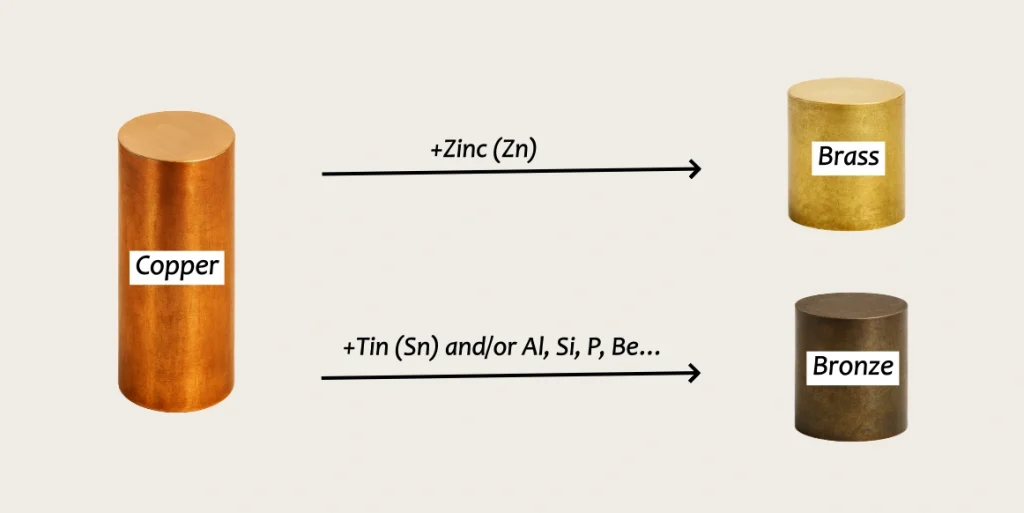
The Basics: Composition at a Glance
The quickest way to understand the difference is to look at their chemical makeup. Here’s a straightforward breakdown:
| Material | Primary Composition | Typical Alloying Elements | Visual Appearance | General Traits |
|---|---|---|---|---|
| Copper | Pure copper (~99% or higher) | Small amounts of oxygen or phosphorus (depending on grade) | Reddish, metallic, bright | Excellent conductivity, soft, ductile |
| Brass | Copper + Zinc (usually 5–40% Zn) | Sometimes with lead, aluminum, tin, nickel | Yellow-gold, shiny | Stronger than copper, excellent machinability, corrosion resistant |
| Bronze | Copper + Tin (commonly 5–15% Sn) | May include aluminum, silicon, phosphorus, manganese | Brownish-red, can darken over time | Hard, wear-resistant, good corrosion resistance, historically important |
This table gives a high-level snapshot. Next, let’s dive into each material in more detail.
Copper: The Base Metal
Copper is one of the oldest metals known to humankind, with a history stretching back over 10,000 years. It occurs naturally in pure form and was one of the first metals ever worked by humans.
- Appearance: Fresh copper has a distinctive reddish-orange glow. Over time, it develops a greenish surface layer called patina (copper carbonate), familiar from the Statue of Liberty.
- Key Properties:
- Excellent electrical and thermal conductivity (second only to silver).
- Very ductile and malleable, making it easy to shape.
- Relatively soft and not as mechanically strong as alloys.
- Common Uses:
Electrical wiring, plumbing tubes, roofing sheets, heat exchangers, and decorative applications. - Drawback: Pure copper is too soft for heavy-duty structural parts, which is why alloys like brass and bronze came into existence.
In short, copper is the parent material—valued for its conductivity and workability, but limited in strength.
Brass: The Copper–Zinc Alloy
Brass is created when zinc is added to copper, and this changes everything. The golden-yellow shine of brass makes it visually appealing, while the zinc addition significantly enhances strength and machinability.
- Appearance:
Brass has a brighter yellow tone than copper or bronze, often resembling gold. This is why it’s a popular choice for musical instruments and decorative items. - Key Properties:
- Stronger and harder than pure copper.
- Excellent machinability—easy to cut, drill, and turn, making it ideal for precision parts.
- Good corrosion resistance, though not as strong in marine environments as bronze.
- Acoustic resonance, which is why it’s widely used in trumpets, saxophones, and other wind instruments.
- Processing:
Brass can be rolled into sheets, extruded into rods, or drawn into tubes. It responds well to cold and hot working methods. - Common Uses:
Valves, fittings, gears, bearings, locks, ammunition casings, musical instruments, and decorative hardware.
One important note: adding a small percentage of lead to brass further improves machinability, but modern regulations restrict this in plumbing applications due to safety concerns.
Bronze: The Copper–Tin Alloy
Bronze was humanity’s first true alloy, giving its name to the Bronze Age around 3000 BC. Adding tin to copper created a material much harder and more durable than copper alone, revolutionizing tools, weapons, and art.
- Appearance:
Bronze has a darker, brownish-red tone compared to brass. With time, it develops a duller, earthy patina. - Key Properties:
- Stronger and harder than both copper and brass.
- Excellent wear resistance, which makes it suitable for bearings and bushings.
- Superior corrosion resistance, especially in seawater—hence its popularity in marine applications.
- Lower friction compared to many metals, reducing wear in moving parts.
- Variants:
Modern bronze isn’t limited to just copper and tin. Aluminum bronze, silicon bronze, and phosphor bronze each bring unique strengths, such as higher strength, better corrosion resistance, or improved elasticity. - Common Uses:
Ship propellers, pump components, sculptures, bearings, bushings, and industrial machinery parts.
Bronze represents a balance of toughness and corrosion resistance, making it indispensable for heavy-duty applications and artistic works alike.
Key Differences Summarized
Now that we’ve gone into detail, let’s put copper, brass, and bronze side by side in terms of performance:
| Property | Copper | Brass | Bronze |
|---|---|---|---|
| Strength | Relatively soft | Stronger than copper | Strongest of the three |
| Machinability | Moderate | Excellent | Good, but less than brass |
| Corrosion Resistance | Good (but prone to patina) | Good, except in saltwater | Excellent, especially in marine environments |
| Conductivity | Very high | Moderate to high | Lower than copper |
| Cost | Moderate | Moderate, varies with zinc content | Slightly higher due to alloying elements |
| Typical Use | Electrical, roofing, piping | Valves, gears, instruments | Marine hardware, bearings, sculptures |
This comparison shows why no single material is universally “better.” Each has its sweet spot.
How to Choose Between Copper, Brass, and Bronze?
When deciding which material to use, here are some guiding questions:
- Need high conductivity? → Choose copper.
- Need good machinability and an attractive gold-like appearance? → Choose brass.
- Need strength, wear resistance, and corrosion resistance in harsh environments? → Choose bronze.
For example:
- A marine engineer designing propellers would lean toward bronze.
- An architect looking for golden door handles might pick brass.
- An electrical engineer specifying cables would insist on copper.
Conclusion: The Family of Copper Alloys
Copper, brass, and bronze may look similar, but they are distinctly different materials with their own strengths and limitations. Copper is the base—soft and conductive. Brass is the versatile, golden alloy—stronger, easier to machine, and visually appealing. Bronze is the workhorse—durable, wear-resistant, and ideal for demanding environments.
By understanding these differences, you can make smarter choices whether you’re designing a new component, sourcing materials, or simply appreciating the artistry of a bronze statue or a brass trumpet. Next time you see a “copper-colored” object, you might pause and ask: Is it really copper, or could it be brass or bronze?